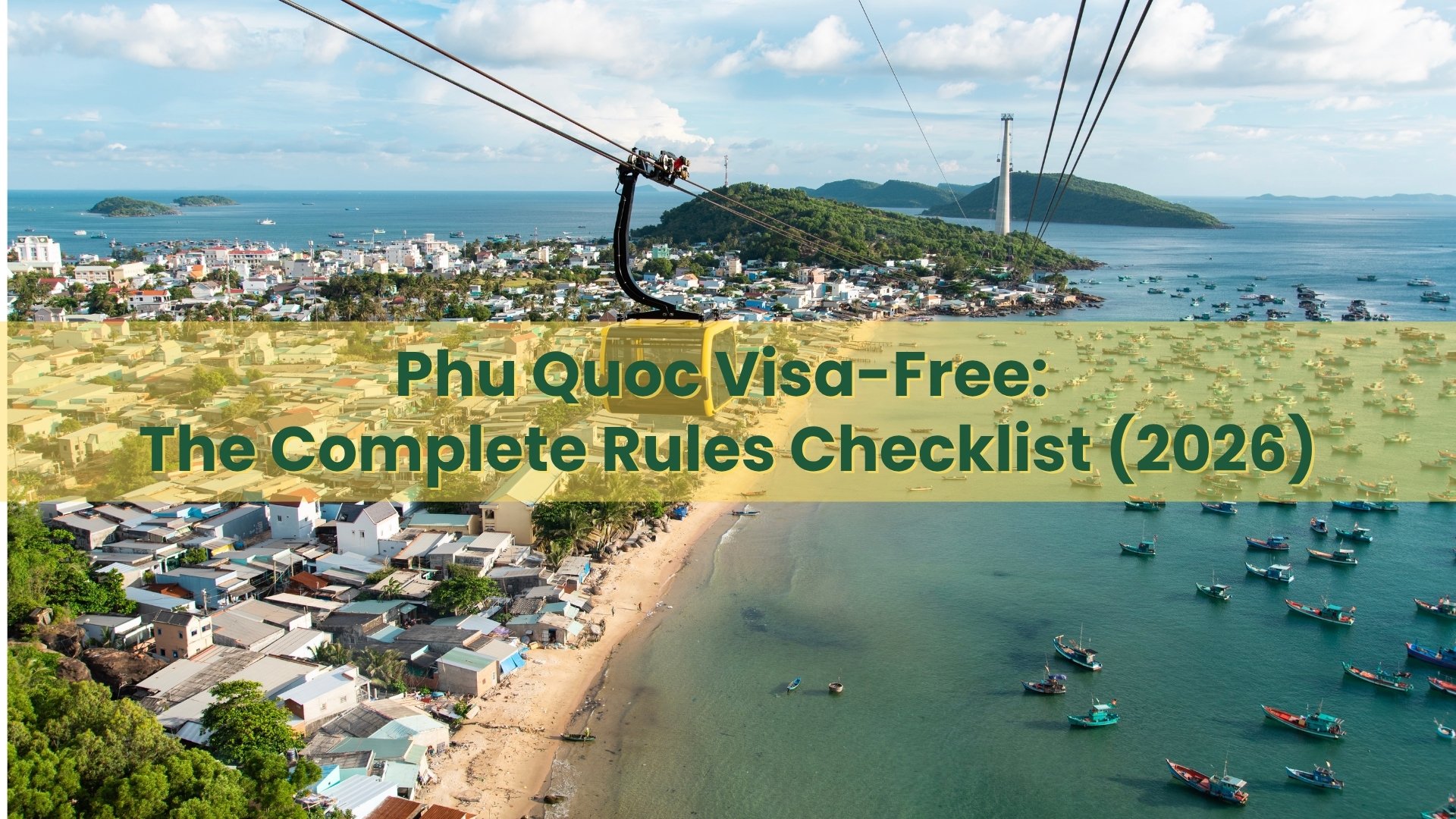
Phu Quoc is the only place in Vietnam where every nationality qualifies for visa-free entry. The island’s 30-day exemption has been in effect since 2014, and it remains one of the most generous entry policies in Southeast Asia.
But “visa-free” does not mean “no rules.” This article is the full checklist. Every condition, every exception, every common mistake, all in one place.
What Is the Phu Quoc Visa Exemption?
The Phu Quoc visa exemption is a special policy issued under Decision No. 80/2013/QD-TTg, signed by the Vietnam Prime Minister on 27 December 2013 and effective from 10 March 2014. It was designed to boost international tourism by removing the visa barrier for short stays on the island.
Under this policy, foreign nationals of any country can enter, stay, and depart Phu Quoc without a Vietnam visa for up to 30 days. The policy also covers Vietnamese citizens holding foreign passports.
Phu Quoc holds this special status because it is classified as a Special Economic Zone under Kien Giang Province. It is the only destination in Vietnam where the visa exemption applies to all nationalities without restriction. For broader context on Vietnam’s Visa Policy, including country-specific exemptions that cover the mainland, refer to the official immigration framework.

Eligibility Checklist: Who Qualifies?
To receive the Phu Quoc visa exemption stamp at immigration, you must meet all of the following conditions. Failing any single one disqualifies you from visa-free entry.
| Condition | Requirement |
| Nationality | Any country. No restrictions. |
| Passport validity | At least 6 months from your date of arrival in Vietnam. |
| Entry point | Phu Quoc International Airport or Phu Quoc seaport. Air or sea only. Land borders do not qualify. |
| Maximum stay | 30 days from the date of entry. |
| Proof of departure | Return ticket or onward booking departing Phu Quoc within 30 days. The destination must be outside Vietnam. |
| Travel scope | You must stay on Phu Quoc Island only. No travel to mainland Vietnam (Hanoi, Ho Chi Minh City, Da Nang, etc.). |
| Clean record | Not on Interpol’s wanted list. No prior deportation from Vietnam. |
If your trip might extend beyond the island, or if your plans are not fully confirmed, it is worth arranging a Vietnam e-visa before departure. The e-visa covers all of Vietnam for up to 90 days and gives you the flexibility to change your itinerary without immigration complications.
Transit Rules: Connecting Through Mainland Vietnam
You do not need to fly nonstop to Phu Quoc to qualify for the exemption.
The policy explicitly covers travelers who transit through another Vietnamese international airport or seaport on their way to Phu Quoc. This includes connecting through Tan Son Nhat (Ho Chi Minh City), Noi Bai (Hanoi), or Da Nang International Airport.
The critical condition: you must stay in the international transit area and not pass through immigration at the mainland airport. If you exit the transit zone, even briefly, you have technically entered mainland Vietnam and the Phu Quoc exemption no longer applies. At that point, you need a valid visa.
Pro Tip: Check with your airline before booking a connection through a mainland airport. Some carriers and routing configurations require passengers to clear immigration and recheck bags, which would void the exemption. If your airline confirms you can stay airside, you are covered.
Documents to Carry
The Phu Quoc visa exemption requires no application, no visa fee, no photos, and no forms. But you need to have the following documents on hand when you arrive:
- Passport valid for at least 6 months from your arrival date
- Return ticket or onward booking showing departure from Phu Quoc within 30 days (the destination must be outside Vietnam)
- Boarding pass or itinerary showing Phu Quoc as your final destination in Vietnam
At the immigration counter, the officer will check your passport and departure proof, then stamp a “Visa Exemption Stamp” in your passport. The stamp records your permitted stay period. No stamping fee applies.
What the Phu Quoc Exemption Does NOT Cover
The exemption is generous for island-only stays, but it has firm boundaries. These are the situations it does not cover:
- Mainland travel. You cannot travel from Phu Quoc to Ho Chi Minh City, Hanoi, Da Nang, or any other mainland destination under this exemption. Attempting to board a domestic flight to the mainland without a visa will be refused.
- Stays longer than 30 days. There is no official mechanism to extend the exemption while remaining on Phu Quoc. Overstaying can result in fines of approximately 1,250,000 VND (around $50 USD) per day, deportation, or a future entry ban.
- Land border entry. Crossing into Vietnam by land from Cambodia or Laos and then traveling to Phu Quoc does not qualify. The exemption applies only to travelers arriving from outside Vietnam by air or sea.
- Already inside Vietnam. If you are already in Vietnam on another visa or exemption and your status is about to expire, you cannot fly to Phu Quoc to reset your stay. The 30-day exemption is exclusively for travelers entering Vietnam from abroad.
What If Your Plans Change? Getting a Visa After Arriving on Phu Quoc
Plans shift. You land on Phu Quoc for a beach holiday, then decide you want to see Ho Chi Minh City or the Mekong Delta. Here are your options:
- Apply for a Vietnam e-visa before leaving Phu Quoc. The e-visa is available to all nationalities, valid for up to 90 days, and supports both single entry ($25 USD) and multiple entry ($50 USD). Standard processing takes 3 to 5 working days. You must apply while outside Vietnam or use a local agency on Phu Quoc to arrange a visa before flying domestically. The Vietnam Immigration Department issues all e-visas through the official portal.
- Use the emergency e-visa service. If you do not have 3 to 5 days to wait for standard processing, you can apply for an expedited e-visa through evisas vietnam. Our urgent service processes your application in just 1 to 4 hours, allowing you to seamlessly adjust your travel plans and fly to mainland Vietnam without delay
For travelers who already know they might explore beyond the island, applying for an e-visa before the trip is the safest approach. The 90-Day Multiple Entry E-Visa guide on the evisas vietnam blog explains how the multiple entry option works, including the first-port rule and re-entry mechanics.
Phu Quoc Visa-Free vs. Vietnam E-Visa: Quick Comparison
Not sure which option fits your trip? This side-by-side comparison covers the key differences.
| Phu Quoc Visa-Free | Vietnam E-Visa | |
| Eligibility | All nationalities | All nationalities |
| Maximum stay | 30 days | Up to 90 days |
| Entry points | Phu Quoc Airport or seaport only | All 83 approved checkpoints (air, land, sea) |
| Mainland access | No. Phu Quoc only. | Yes. All of Vietnam. |
| Government fee | Free | $25 (single entry) / $50 (multiple entry) |
| Application required | No | Yes, online via official portal |
| Processing time | None | 3 to 5 working days (standard) |
| Extensions | Not available on the island | Not extendable; reapply after expiry |
If your trip is a Phu Quoc beach holiday with a confirmed departure within 30 days, the visa-free exemption covers you completely at no cost. If there is any chance your plans include mainland Vietnam, or if your itinerary is flexible, the e-visa is the more reliable choice. See the full breakdown of e-visa processing tiers and pricing on the evisas vietnam website.
Before You Book
Phu Quoc’s visa-free entry is one of the easiest ways to reach Vietnam for a short stay. No application, no fee, no embassy visit. But the exemption only works if every condition on the checklist above is met. The most common problems happen when travelers assume the rules are looser than they are, especially around transit routing, mainland access, and the 30-day limit.
If your itinerary is fixed to Phu Quoc, you are covered. If your plans might shift, or if you want the flexibility to explore the mainland, a Vietnam e-visa removes the guesswork entirely.
evisas vietnam’s team reviews every application before submission to catch errors in dates, passport details, and entry points that could cause delays or rejections. If you want a second set of eyes on your application, or need faster processing, the team is available to help. All Vietnam e-visas are issued by the Vietnam Immigration Department.