
Vietnam E-Visa for Remote Workers & Digital Nomads (2026)
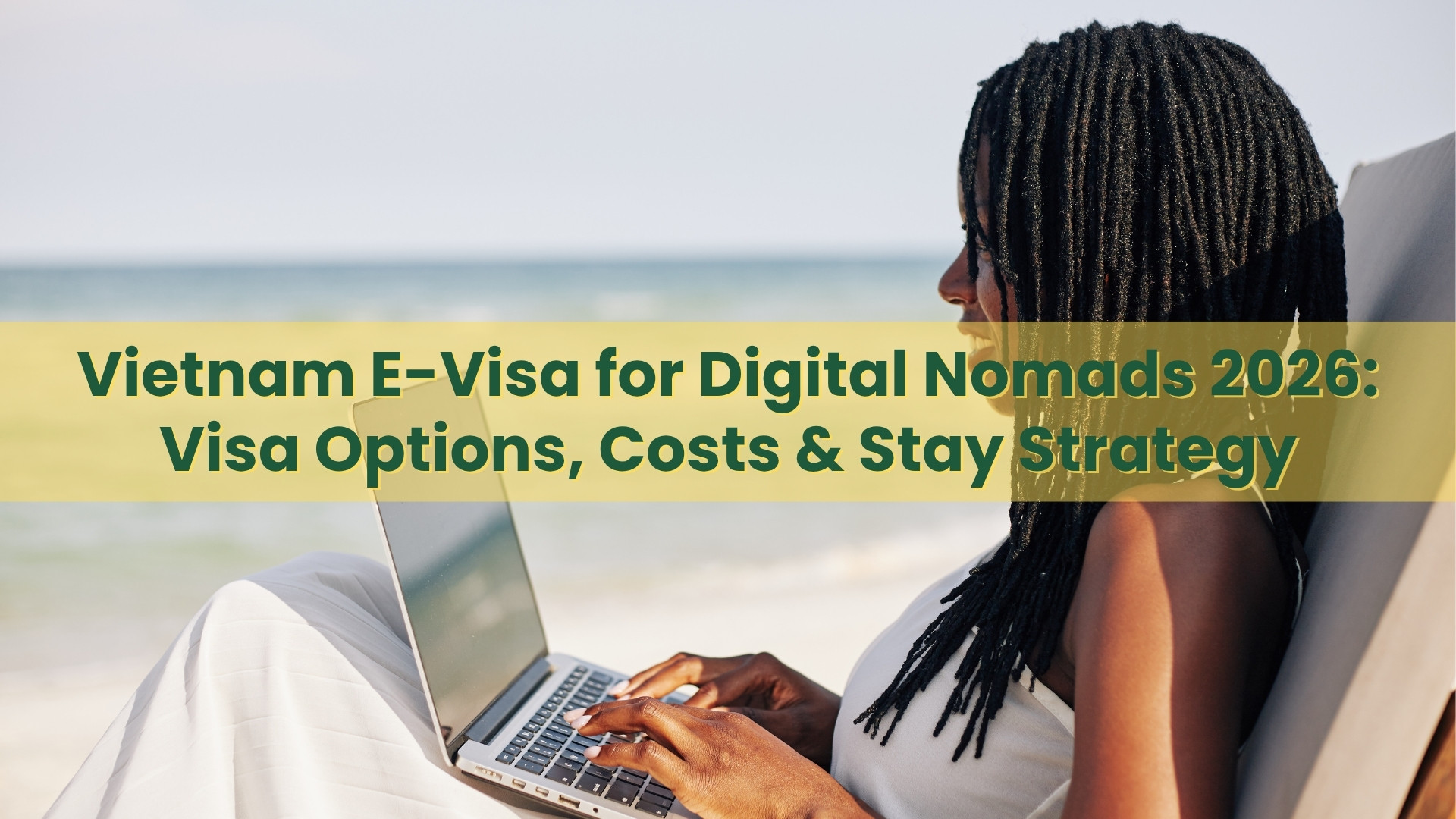
Vietnam checks every box for remote workers: affordable living ($1,000 to $1,500/month), fast internet, world-class street food, and a growing coworking scene in cities like Ho Chi Minh City, Da Nang, and Hanoi.
But there is one thing Vietnam does not have: a digital nomad visa.
This guide cuts through the noise. You will find exactly which visa to use, how to apply, how to stay long-term through visa runs, and what it actually costs to live and work remotely in Vietnam in 2026.
Does Vietnam Have a Digital Nomad Visa?
No. As of 2026, Vietnam does not offer a dedicated digital nomad visa. Three terms get thrown around online, but only one is useful for remote workers.
| Visa Term | Status in 2026 | Who It Is For | Useful for Nomads? |
| E-Visa (90 days) | Available now | All nationalities, all purposes | Yes. This is your real option. |
| Talent Visa / SVEC (5-year) | Live since Aug 2025 | PhD scientists, senior executives, prominent artists | No. Extremely high bar. |
| Golden Visa (10-year) | Proposal only | Long-term residents, investors (proposed) | No. No application portal exists. |
The 90-day e-visa is what the vast majority of remote workers in Vietnam use. It is available to citizens of all countries and territories, supports multiple entries, and the entire application is online. Our company, evisas vietnam can help review and submit your application to reduce the risk of errors.
Vietnam Visa Options for Remote Workers at a Glance
The table below compares every realistic entry option for remote workers in 2026.
| Option | Max Stay | Cost (USD) | Multiple Entries? | Best For | Can Extend? |
| Visa-Free Entry | 45 days (varies) | Free | No (single entry) | Short test stays, EU/UK passport holders | No |
| Single-Entry E-Visa | 90 days | $25 | No | One-time trips, no side trips planned | No |
| Multiple-Entry E-Visa | 90 days | $50 | Yes, unlimited | Digital nomads, regional base | No |
| Business Visa (DN) | Up to 90 days | Varies | Yes (if multi-entry) | Sponsored workers with a Vietnamese company | Yes, in some cases |
| Visa on Arrival | Up to 90 days | $25 + stamping fee | Yes (if multi-entry) | Tour groups, agency-arranged travel | Limited |
For most digital nomads, the 90-day multiple-entry e-visa ($50) is the clear winner. It lets you exit to neighbouring countries and return without reapplying.
Read the full breakdown in our multiple-entry e-visa guide.

How to Apply for a Vietnam E-Visa (Step by Step)
Before you start, gather these documents:
| Requirement | Details |
| Passport | Valid for at least 6 months beyond your arrival date |
| Passport scan | High-resolution colour scan of the bio-data page. MRZ lines fully visible. |
| Portrait photo | 4×6 cm, white background, no glasses, ears visible. Do NOT use a photo of your passport photo. |
| Travel details | Intended entry date, entry port, exit port |
| Payment method | Credit or debit card (Visa/Mastercard) |
Then follow these five steps:
- Go to the official portal at evisa.gov.vn or apply through a private agency for guided support.
- Fill in your personal and travel details. Vietnam uses DD/MM/YYYY date format. Double-check this.
- Upload your passport scan and portrait photo. Both must meet the specifications above.
- Pay the government fee online: $25 (single entry) or $50 (multiple entry).
- Receive your e-visa PDF by email within 3 to 5 working days. Print it and carry it with you.
Pro Tip: Choose your start date carefully. Your 90-day window begins on the date you select, not the date you actually arrive. Set it for the day you plan to enter Vietnam to maximise your stay.
If you want a second set of eyes on your application before it goes to the Vietnam Immigration Department, evisas vietnam’s team reviews submissions to catch errors like inverted dates, blurry scans, or mismatched passport numbers.
The 90-Day Strategy: How Digital Nomads Stay Long-Term
The e-visa cannot be extended or renewed from inside Vietnam. Once your 90 days are up, you must leave the country and apply for a new e-visa from abroad.
This is called a “visa run.” Thousands of digital nomads do it routinely. Here is how the cycle works:
- Live and work in Vietnam for up to 90 days on your e-visa.
- Exit Vietnam before your visa expires. Fly or bus to a neighbouring country.
- Apply for a new 90-day e-visa while abroad (processing takes 3 to 5 working days).
- Re-enter Vietnam on your new visa. Repeat.
Popular Visa Run Destinations
| Destination | From Vietnam | Typical Cost | Travel Time | Popular With |
| Cambodia (Phnom Penh) | Bus or flight from HCMC | $30-80 (bus) / $60-150 (flight) | 6-7 hrs (bus) / 1 hr (flight) | HCMC-based nomads |
| Thailand (Bangkok) | Flight from any major city | $80-200 (flight) | 1.5 hrs | Nomads wanting a city break |
| Laos (Vientiane) | Bus from Hanoi / flight | $40-100 (bus) / $100-180 (flight) | 12+ hrs (bus) / 1.5 hrs (flight) | Hanoi-based nomads |
| Philippines (Manila/Cebu) | Flight from HCMC/Da Nang | $100-250 (flight) | 2-3 hrs | Nomads exploring SE Asia |
Important: Overstaying your visa triggers fines starting at approximately 500,000 VND per day (about $20 USD) and can lead to blacklisting. Track your expiry date and plan your exit well in advance.

Best Cities in Vietnam for Remote Workers (2026)
| City | Monthly Budget | Internet Speed | Vibe | Best For |
| Ho Chi Minh City | $1,200-2,000 | 50-150 Mbps | Fast-paced, urban, 24/7 energy | Networking, nightlife, big-city nomads |
| Da Nang | $900-1,300 | 100-500 Mbps | Beach + city balance, relaxed | Beach lovers, work-life balance |
| Hanoi | $1,000-1,500 | 50-100 Mbps | Cultural, historic, cooler climate | Culture seekers, foodies |
| Hoi An | $800-1,100 | 30-80 Mbps | Slow, charming, ancient town | Creatives, deep focus, small community |
Da Nang is the top pick for most digital nomads in 2026. It combines a genuine beachfront with fast fibre internet, affordable coworking (from $80/month), and a critical mass of other remote workers.
Ho Chi Minh City is better for those who want maximum networking, nightlife, and the energy of a megacity. Thao Dien (District 2) and District 3 are the most popular nomad neighbourhoods.
Hoi An suits creatives and deep-focus workers who want a quieter pace. The ancient town is a UNESCO World Heritage Site and the surrounding area has a growing coliving scene.

Cost of Living Snapshot for Digital Nomads
All figures are monthly estimates in USD. Costs vary by city; HCMC is generally the most expensive, Hoi An the least.
| Expense | Budget ($800-1,000) | Comfortable ($1,200-1,500) | Premium ($1,800-2,500) |
| Rent (studio/1BR) | $200-350 | $400-600 | $700-1,000 |
| Food & coffee | $150-250 | $300-400 | $450-600 |
| Coworking | $0 (cafe only) | $80-120 | $120-200 |
| Transport (scooter/Grab) | $30-50 | $50-80 | $80-150 |
| SIM + home internet | $10-20 | $15-25 | $20-30 |
| Lifestyle (gym, trips, social) | $50-150 | $150-250 | $250-400 |
| Total | $440-820 | $995-1,475 | $1,620-2,380 |
Pro Tip: Street food meals cost $1 to $3. A bowl of pho is about $1.50. Specialty coffee is $2 to $4. You can eat extremely well on a low budget in Vietnam.
Frequently Asked Questions
Does Vietnam have a digital nomad visa?
No. As of 2026, there is no dedicated digital nomad visa. The 90-day multiple-entry e-visa is the most practical option for remote workers. A “Golden Visa” has been proposed but has no launch date or application portal.
Can I extend my e-visa inside Vietnam?
No. The Vietnam Immigration Department does not allow e-visa extensions or renewals from within the country. You must exit and apply for a new e-visa from abroad.
What happens if I overstay my visa?
Fines start at approximately 500,000 – 2,000,000 per day (about $20-76 USD). Extended overstays can result in blacklisting, which prevents future visa approvals. Do not overstay.
Is the 90-day e-visa available to all nationalities?
Yes. Since the 2023 expansion, the Vietnam e-visa is available to citizens of all countries and territories worldwide. You can apply through the official portal at evisa.gov.vn or through evisas vietnam for guided support.
What is the 183-day tax rule?
Under Vietnamese tax law, you are considered a tax resident if you spend 183 days or more in Vietnam within a calendar year. This can trigger local tax obligations. If you plan to stay long-term through repeated visa runs, consult a tax professional about your home country and Vietnam obligations.
Ready to Get Started?
Vietnam’s visa framework is not perfect for digital nomads yet. There is no dedicated visa, no in-country extension, and long-term stays require periodic border exits. But the 90-day multiple-entry e-visa, combined with affordable visa runs to neighbouring countries, is a workable system that thousands of remote workers rely on every year.
The most important thing is getting your application right the first time.
If you want your application reviewed for errors before submission, or need faster processing, evisas vietnam’s team can help. Every application is manually reviewed by visa specialists before it reaches the Vietnam Immigration Department.